


Staff Augmentation as a Strategic Business Solution for CEOs

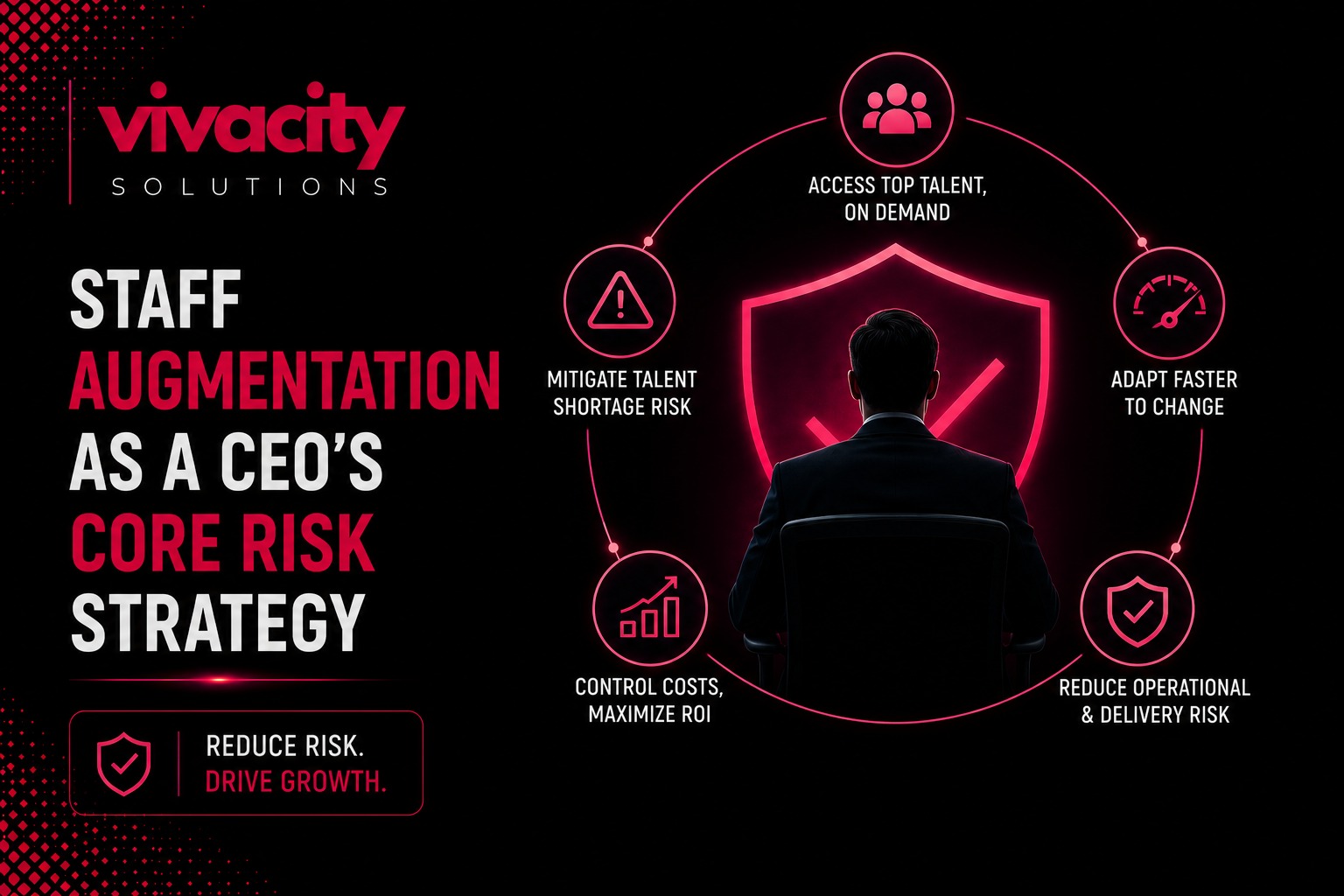
Let me tell you something that keeps CEOs awake at night. The pace of technological change is accelerating faster than most organizations can adapt. AI is reshaping entire industries. Customer expectations are evolving constantly. And the talent you need to navigate this disruption is either unavailable or too expensive to hire permanently.
I have watched CEOs make the mistake of relying solely on permanent headcount to execute their digital transformation strategies. They hired aggressively during boom times. Then, when priorities shifted or budgets tightened, they faced painful layoffs, damaged morale, and strategic whiplash. Their competitors, however, had figured out a different approach.
They embraced staff augmentation as a strategic business solution. They built flexible workforce strategies that allowed them to access technical talent on demand, scale up for critical projects, and scale down without the emotional and financial cost of layoffs. They treated workforce augmentation not as a temporary fix but as a core risk management tool.
If you are a CEO who is still thinking of staff augmentation as a tactical staffing solution rather than a strategic business solution, you are exposing your organization to unnecessary risk. Let me show you why workforce agility is now a CEO-level priority and how staff augmentation can protect your business.
Why Workforce Strategy Is Now a CEO Priority
The role of the CEO has changed. It is no longer enough to set the vision and delegate execution. Today's CEOs must actively manage the talent supply chain as a critical business function.
The Talent Risk Is Systemic
The technical talent shortage is not going away. Demand for hyper-specialized skills in AI, machine learning, cloud architecture, and security continues to outpace supply. Companies that cannot access the right skills at the right time will fall behind.
Technology Shifts Are Unpredictable
Who predicted the explosive growth of generative AI just two years ago? Technology shifts happen fast. The skills you need today may not be the skills you need tomorrow. A workforce strategy built entirely on permanent headcount is brittle. A flexible workforce strategy is resilient.
The Cost of Getting It Wrong Is High
Over-hire and you face layoffs, reputational damage, and operational disruption. Under-hire and you miss market opportunities, lose customers, and fall behind competitors. The cost of getting workforce planning wrong is measured in millions.
This is why staff augmentation as a strategic business solution has moved from the IT department to the boardroom. CEOs understand that workforce agility is not just about hiring. It is about operational resilience and business agility.
What Is Staff Augmentation as a Strategic Business Solution?
Let me define staff augmentation as a strategic business solution in the context of CEO-level decision-making.
Beyond Tactical Staffing
Many executives think of staff augmentation as a way to fill temporary gaps. A developer leaves unexpectedly. You need extra hands for a deadline. You bring in contractors to cover the shortfall. This is tactical staffing.
Staff augmentation as a strategic business solution is different. It is a deliberate, long-term approach to building technical capacity that aligns with your innovation strategy. You build a core team of permanent employees for your critical, ongoing work. You use managed software delivery teams and augmented talent for everything else.
Capability-Based Workforce Strategy
A capability-based workforce strategy starts with the question: What capabilities do we need to execute our strategy? Then it asks: Which capabilities must be permanent, and which can be on demand?
This is the essence of staff augmentation as a strategic business solution. You are not just filling headcount. You are building delivery capabilities that match your business needs.
On-Demand Capabilities
With on-demand capabilities, you access external talent exactly when you need it. No long-term commitments. No overhead. No risk of idle capacity. This is the future of workforce planning.
4. The CEO's Nightmare: Talent Risk and Market Volatility
Let me describe the CEO's nightmare scenario.
The Talent Trap
You have a critical project. It requires hyper-specialized skills that you do not have on your team. You post job listings. You work with recruiters. You wait months. The project gets delayed. Your competitors launch first. Customers choose them over you.
The Headcount Trap
You hire aggressively to build capacity. Then the market shifts. A major client delays their project. Budgets are cut. You have more permanent headcount than you need. You are forced into layoffs. You lose talent you spent years developing. Your employer brand is damaged.
The Technology Trap
You invest heavily in a technology stack and hire permanent employees with those skills. Then the technology shifts. AI changes the game. You need different skills now. Your permanent team is not equipped. You are stuck with legacy skills and legacy thinking.
The Risk Is Real
This is not theoretical. I have seen companies suffer from each of these scenarios. The common thread is a workforce strategy that is too rigid, too slow, and too dependent on permanent headcount.
Staff augmentation as a strategic business solution is the antidote. It provides the workforce flexibility to adapt to changing conditions without the risk of over-hiring or under-hiring.
How Staff Augmentation Mitigates Business Risk
Let me walk you through the specific risks that staff augmentation mitigates.
Resource Risk
When you rely on permanent headcount, your capacity is fixed. If a key person leaves, you lose their entire capacity until you hire a replacement. With staff augmentation, you can quickly access engineering experts to fill gaps. Your capacity is resilient.
Financial Risk
Permanent headcount comes with fixed costs. Salaries, benefits, taxes, equipment. These costs continue regardless of demand. With staff augmentation, you pay only for what you use. Your costs scale with your workload. This reduces financial risk.
Strategic Risk
When technology shifts, your permanent team may not have the required skills. With staff augmentation, you can access hyper-specialized skills on demand. You can pivot without retraining or hiring. This reduces strategic risk.
Operational Risk
When your team is overworked, productivity drops and quality suffers. Burnout leads to turnover. Staff augmentation brings in technical talent to share the load. Your core team stays fresh and productive. This reduces operational risk.
Reputational Risk
When projects are delayed, customers become frustrated. They may leave negative reviews or switch to competitors. Staff augmentation accelerates software delivery, keeping customers happy. This reduces reputational risk.
Speed to Market: The Competitive Advantage
Let me talk about one of the biggest benefits of staff augmentation as a strategic business solution: speed to market.
The Speed Imperative
In today's fast-paced business environment, speed to market is everything. The company that ships first captures market share. The company that ships last plays catch-up.
Traditional Hiring vs. Staff Augmentation
Traditional hiring takes months. By the time you hire, onboard, and ramp up a new employee, your competitors have already shipped their features.
Staff augmentation places technical talent within days. These engineers are productive within weeks. You accelerate your software delivery and beat competitors to market.
The Risk of Being Slow
Being slow to market is not just an inconvenience. It is a business risk. You lose customers. You lose revenue. You lose market share. Staff augmentation as a strategic business solution gives you the speed you need to stay competitive.
AI Projects and the Need for Hyper-Specialized Skills
Let me address one of the biggest drivers of staff augmentation demand in 2026: AI.
The AI Talent Gap
Demand for AI and machine learning talent far exceeds supply. AI projects require hyper-specialized skills that are difficult to find and expensive to hire permanently.
AI Development Is Different
AI development is different from traditional software development. It requires expertise in machine learning, data science, and neural networks. It is not something you can learn quickly.
The Staff Augmentation Solution
With staff augmentation, you can access AI engineers and machine learning experts on demand. You do not need to compete with tech giants for permanent talent. You bring in specialists exactly when you need them.
AI Tools and Integration
Beyond development, AI tools require integration with existing systems. This requires technical expertise that most permanent teams lack. Staff augmentation provides the engineering experts who can handle these complex integrations.
The Risk of Not Acting
Companies that delay AI projects because they cannot find talent risk falling behind. Their competitors will adopt AI and gain efficiency. The gap will widen. Staff augmentation removes the talent barrier to digital transformation.
Operational Resilience Through Workforce Flexibility
Let me explain how workforce flexibility builds operational resilience.
What Is Operational Resilience?
Operational resilience is the ability of an organization to continue delivering value in the face of disruption. It is about being able to adapt quickly to changing conditions.
How Permanent Headcount Reduces Resilience
Permanent headcount reduces resilience. When demand drops, you have fixed costs. When technology shifts, you have fixed skills. When a key person leaves, you have a fixed gap. There is no flexibility.
How Staff Augmentation Builds Resilience
Staff augmentation builds resilience by providing workforce flexibility. You can scale up when demand increases and scale down when it decreases. You can access new skills as technology evolves. You can fill gaps quickly when someone leaves.
Distributed Teams and Nearshore Partners
Distributed teams and nearshore partners add another layer of resilience. If a local team is disrupted, you have talent in other locations. Your technology workforce is not dependent on a single geography.
The Bottom Line
Operational resilience is a CEO-level priority. Staff augmentation as a strategic business solution is the tool that delivers it.
Staff Augmentation vs Permanent Headcount
Let me give you a direct comparison of risk between the two models.
Fixed vs Variable Costs
Permanent headcount creates fixed costs. You pay salaries and benefits regardless of demand. Staff augmentation creates variable costs. You pay only for what you use. Variable costs are lower risk.
Scalability
Permanent headcount is difficult to scale. You need to hire or lay off to change capacity. Staff augmentation is easy to scale. You add or remove resources as needed. Easy scalability is lower risk.
Skill Availability
Permanent headcount depends on what you can hire. If the skills you need are scarce, you may not be able to build the team. Staff augmentation gives you access to a global talent supply chain of technical expertise. Global access is lower risk.
Technology Shifts
Permanent headcount locks you into skills that may become obsolete. Staff augmentation lets you adapt quickly to technology shifts. Adaptability is lower risk.
The Risk Verdict
Staff augmentation consistently offers lower risk across all dimensions. This is why CEOs are embracing staff augmentation as a strategic business solution.
10. Building a Capability-Based Workforce Strategy
Let me show you how to build a capability-based workforce strategy that uses staff augmentation as a core component.
Step 1: Define Your Capabilities
Start by defining the capabilities your business needs to execute its strategy. What skills are critical? What roles are core to your value proposition?
Step 2: Assess Your Current Workforce
What capabilities do you have on your permanent team? What gaps exist? Where are you over-invested? Where are you under-invested?
Step 3: Decide What to Keep Permanent
Some capabilities should remain permanent. Leadership, core intellectual property, and strategic functions. These roles need deep integration and long-term commitment.
Step 4: Identify What Can Be On-Demand
Other capabilities can be delivered through staff augmentation. Project-based work, specialized skills, variable demand. These are perfect for managed software delivery teams.
Step 5: Build Your Talent Supply Chain
Partner with staff augmentation services providers who can deliver the external talent you need. Build relationships with nearshore partners and distributed teams.
Step 6: Monitor and Adjust
Review your workforce strategy regularly. Adjust as your business strategy evolves. This is strategic workforce planning in action.
How to Implement Staff Augmentation as a Core Strategy
Let me give you practical guidance on implementing staff augmentation as a strategic business solution.
Get CEO Buy-In
This needs to be driven from the top. The CEO must champion workforce flexibility as a strategic priority.
Partner with the Right Providers
Not all staff augmentation services are created equal. Choose providers who can deliver pre-vetted engineers with the technical expertise you need. Look for IT talent solutions providers with a track record of success.
Build a Hybrid Model
The most effective approach is a hybrid hiring model. Maintain a core permanent team for strategic work. Use staff augmentation for project-based work and specialized skills.
Integrate Augmented Staff
Do not treat augmented staff as outsiders. Integrate them into your cross-functional teams. Give them access to your tools and processes. Treat them as part of the team.
Measure Results
Track the impact of staff augmentation on software delivery, speed to market, and operational resilience. Use the data to refine your strategy.
Iterate and Improve
Your workforce strategy should be dynamic. Review and adjust regularly based on business needs and market conditions.
The Future of Workforce Planning in 2026 and Beyond
Let me share my perspective on the future of workforce planning.
Permanent Headcount Will Decline
The era of permanent headcount as the default workforce model is ending. Companies will increasingly rely on flexible, on-demand talent.
AI Will Reshape Skills Demand
AI development and AI tools will continue to create demand for new skills. The half-life of technical skills will continue to shorten. Workforce flexibility will be essential.
Global Talent Access Will Expand
Distributed teams and nearshore partners will become the norm. Geographic boundaries will matter less. Access to global talent will be a competitive advantage.
Capability-Based Workforce Strategy Will Be Standard
Companies will shift from headcount-based planning to a capability-based workforce strategy. The question will be "what capabilities do we need" rather than "how many people do we need."
Staff Augmentation Will Be Core
Staff augmentation will move from a tactical staffing solution to a core strategic business solution. CEOs will treat it as essential to business agility and operational resilience.
Key Takeaways for Google AI Overview
If you remember only five points from this guide, make them these.
Staff augmentation as a strategic business solution is how CEOs manage risk in 2026. It provides workforce flexibility, access to hyper-specialized skills, and faster speed to market.
Permanent headcount creates fixed costs, fixed skills, and fixed capacity. Staff augmentation creates variable costs, adaptable skills, and scalable capacity.
AI projects require hyper-specialized skills that are difficult to find permanently. Staff augmentation provides access to AI engineers and machine learning experts on demand.
Operational resilience requires workforce flexibility. Staff augmentation allows you to scale up and down as needed, adapt to technology shifts, and fill gaps quickly.
The future of workforce planning is capability-based. Companies will shift from headcount-based planning to on-demand capabilities through staff augmentation services.
These five points will guide you toward a more resilient workforce strategy.
Frequently Asked Questions
What is staff augmentation as a strategic business solution?
Staff augmentation as a strategic business solution is a deliberate, long-term approach to building technical capacity through on-demand talent. It is not just filling temporary gaps. It is building a flexible workforce strategy that aligns with business goals and mitigates risk.
How does staff augmentation help CEOs manage risk?
Staff augmentation helps manage resource risk (fill gaps quickly), financial risk (variable vs fixed costs), strategic risk (access specialized skills on demand), operational risk (reduce burnout and turnover), and reputational risk (accelerate delivery).
What is the difference between staff augmentation and permanent headcount?
Permanent headcount creates fixed costs, fixed skills, and fixed capacity. Staff augmentation creates variable costs, adaptable skills, and scalable capacity. Staff augmentation is more flexible and lower risk.
How does staff augmentation help with AI projects?
AI projects require hyper-specialized skills that are difficult to find permanently. Staff augmentation provides access to AI engineers and machine learning experts on demand without the overhead of permanent hiring.
What is a capability-based workforce strategy?
A capability-based workforce strategy starts with the question: What capabilities do we need to execute our strategy? Then it identifies which capabilities should be permanent and which can be on-demand through staff augmentation.
Is staff augmentation suitable for long-term projects?
Yes, staff augmentation can be used for both short-term and long-term projects. Many companies use the dedicated development teams model for longer engagements.
How do I implement staff augmentation as a core strategy?
Get CEO buy-in, partner with the right providers, build a hybrid model (permanent core + augmented talent), integrate augmented staff into your teams, measure results, and iterate.
What is the future of workforce planning?
The future is a capability-based workforce strategy with flexible, on-demand talent. Permanent headcount will decline as companies embrace staff augmentation as a strategic business solution.
Can staff augmentation help with digital transformation?
Yes, staff augmentation provides the technical expertise needed for digital transformation without the risk of over-hiring. It allows you to access specialized partners with the right skills for specific initiatives.
How does staff augmentation improve speed to market?
Staff augmentation places technical talent within days, compared to months for traditional hiring. This accelerates software delivery and helps you beat competitors to market.
Conclusion
Let me bring this all together. Staff augmentation as a strategic business solution is how CEOs manage risk in 2026. It provides workforce flexibility, access to hyper-specialized skills, and faster speed to market.
The days of relying solely on permanent headcount are ending. The pace of technological change is too fast. The talent shortage is too severe. The cost of getting workforce planning wrong is too high.
Staff augmentation gives you the operational resilience you need to navigate uncertainty. You scale up when you need to, scale down when you do not, and access technical expertise exactly when you need it.
Workforce agility is not just an HR initiative. It is a CEO-level priority. It is a risk management tool. It is a competitive advantage. It is the future of workforce planning.
Your Next Step
Ready to build a more resilient workforce strategy? Contact our IT services company, Vivacity Solutions, today for a free consultation. We will help you assess your workforce needs, build a capability-based strategy, and access the technical talent you need. No pressure. Just honest advice from experienced professionals.
Get Your Free Workforce Strategy Consultation
Comments (0)
No comments yet. Be the first to share your thoughts!
Leave a Comment